الوضع الليلي
0
Mandarin-fish
8:57:49 2024-03-26 2576

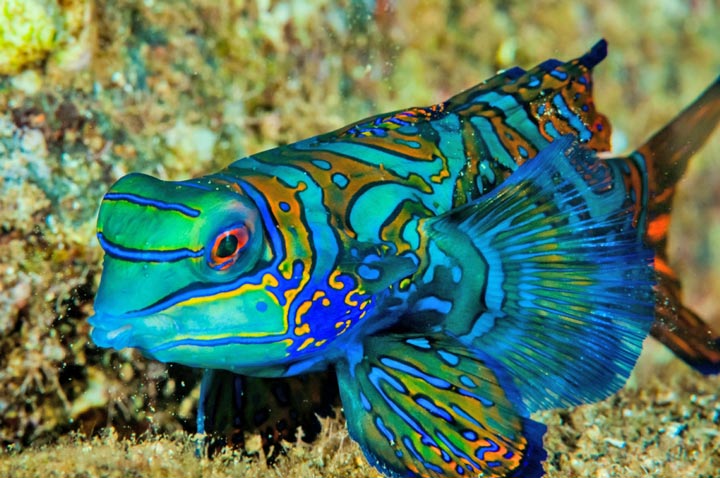
Mandarin fish have got to be one of the most colourful and truly ornate looking fish that we see in the Indo-Pacific. During the day time, whilst we do have occasional sightings, these little critters lay low and hide within the branches of staghorn corals. During sunset however, they leave the reef and perform one of nature’s most magnificent and flamboyant of mating rituals. It’s possible to see Mandarin fish at almost all of our incredible diving locations in Indonesia. Here are some Mandarin fish facts which you may not know, followed by our hotspots for sightings.

FUN FACTS ABOUT MANDARIN FISH:

  • Mandarin fish (Pterosynchiropus splendidus) are also known by several other common names, including the Mandarin Dragonet, Mandarin Goby, Green Mandarin fish, Striped Mandarin fish and the Psychedelic fish.
  • These little beauties are a small species only reaching about 3 inches in length.
  • This species is best known for its ritual reproduction mating “dance” which only occurs during sunset hours. Females will group together at the reef and seek a male mate. The males then begin to court the females, the bigger and stronger males are more likely to be chosen. Males also can reproduce with multiple females in a night. The male and female pair attaches at the pelvic fin and swim to the top of the reef where they release the eggs and sperm in a cloud (about 200 eggs). Once the egg and sperm clouds have been released the pair part ways and the courtship ends. The fertilized eggs take only 18-24 hours to hatch into larvae, then after two weeks of drifting, they settle into the reef.
  • Mandarin fish they are very picky eaters. They eat mainly small worms, protozoans, and small crustaceans. The majority of our mandarin fish dive sites have areas of sand and patches of staghorn (branching corals). These sites are ideal as they provide protective corals and food for the fish.
  • Scorpionfish are one of their most known predators.
  • One of the biggest threats to mandarin fish comes from mankind and the tropical fish tank industry in which they are highly prized. Individual fish can sell for up to USD $150 – it has also recently been proven that, like many fish, they live up to 4 times longer in the wild than they do in captivity.


  • Did you know that these fish do not have scales? Instead, they secrete mucus from their skin, which helps repel predators and keep them clean from parasites. Also, their bright coloration is not for attracting a mate, instead, it is to mislead predators into believing that they may be toxic to consume.
  • Bold Colours but not bold characters: Mandarin fish are actually very skittish and shy, so they prefer to avoid other fish. This makes our mandarin dive site in Lembeh quite unique as they are often spotted living quite harmoniously in the staghorn corals with pajama cardinalfish and the endemic Banggai cardinalfish.


Reality Of Islam

MOST VIEWS

Importance of Media

9:3:43   2018-11-05

Illuminations

remember who supported you

2:2:13   2022-10-08

your life

2:11:12   2022-10-15

your character

2:33:4   2023-02-15

bahlool & a businessman

8:21:9   2018-06-21

abbas-ibn-firnas

3:42:22   2021-12-24

bahlool & the khalifa`s food

8:19:41   2018-06-21


IMmORTAL Words
LATEST A Simple Pill Could Treat Diabetic Eye Damage Before Vision Is Lost A Diamond Smaller Than a Grain of Rice Could Transform Heart Monitoring Arctic Landslide Triggers 1,580-Foot Tsunami in Alaska Brain Differences May Explain Why Some Children Struggle at Math Tiny Diamond Beams Could Unlock More Powerful Quantum Networks He Was Looking for a Campsite. He Found a Massive Impact Crater Mission to Destroy the Idolatrous Temple of al-Fuls The Last Sermon from the Holly Prophet (Peace and Blessings Be Upon Him and His Progeny) Guidance Recommendations for Parents of a Child with an Intellectual Disability Where Does Fat Go When You Lose Weight? The Answer May Surprise You New Space Telescope from NASA Could Bring Alien Worlds into View Like Never Before Even After 300 Years, Scientists Find Recovering Grasslands Can Remain Fundamentally Different