Affixation and stem alternations
Since our focus in the non-Kujamaat-Jóola portions has been on English, we have had ample opportunity to look at the expression of inflection through affixation. In English, this is the most common means by which inflectional categories are expressed. For that reason we do not address affixation on its own here. Instead we present it with stem alternations, another means of expressing inflection in the world’s languages. We wish to emphasize that just as affixation does not necessarily occur with stem alternations, stem alternations do not necessarily occur with affixation. We present them together merely for organizational purposes.
Latin, discussed briefly in Exponence, is one language where in many cases, affixation interacts obligatorily with stem alternations in the expression of inflectional categories. Above we gave the example of rēxistıֿ ‘you ruled’. The perfective stem rēx- can be contrasted with the present stem reg-. It supplements affixation in the expression of the perfect. Below we give further examples of Latin present stems alongside perfective stems. The expression of the perfect would involve not only the perfective stem, but also a series of suffixes:
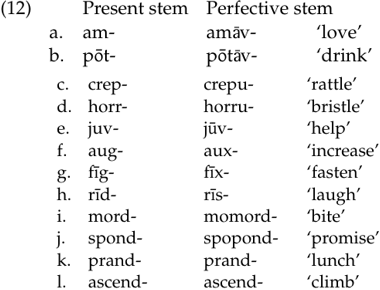
In (12) we have listed a variety of alternation types that present–perfective stems fall into in Latin, but we do not attempt to be fully comprehensive. (12a–b) show the regular way of forming perfective stems from present stems in the so-called first conjugation of Latin (verbs whose infinitive ends in -āre). (12c–d) are examples of verbs that have a perfective stem in -u. In (12e) we see an example of a verb whose stem vowel lengthens in the perfective. Examples (12f–h) have a perfective stem in -s. (What is written x was pronounced [ks].) (12i–j) display reduplication in the perfective stem. Finally, in (12k–l) we see that for some verbs, the present and perfective stems are identical.
Stem alternations are also a major exponent of inflection in the Apachean languages, a subset of Athapaskan which includes both Navajo and Apache. Active verbs in the Apachean languages are those that describe processes (e.g., ‘become white’) or movements and actions (e.g., ‘walk’, ‘jump’, ‘throw’). They contrast with neuter verbs, which generally express a state of being or position (e.g., ‘be white’, ‘be sit ting’). Active verbs are regularly conjugated in several paradigms: imperfective, perfective, progressive, future, customary, iterative, and optative. The expression of these inflectional categories can generally be described as extended exponence, since it involves both prefixes and, sometimes, a special stem. Some active verbs have two conjugation patterns. The two patterns express aspectual contrasts such as momentaneous vs. continuative, which are distinguished principally through stem alternations. In (13) we provide the stems of the Navajo verb meaning ‘handle a round object’. The first set of stems are those that occur in the momentaneous; the second set are those found in the continuative. (The discussion in this paragraph is paraphrased from Hoijer 1971: 130, and the examples come from there, as well.) In the following examples, vowels with hooks under them are nasalized, and acute accents mark high tone. This is in accordance with Navajo orthography.
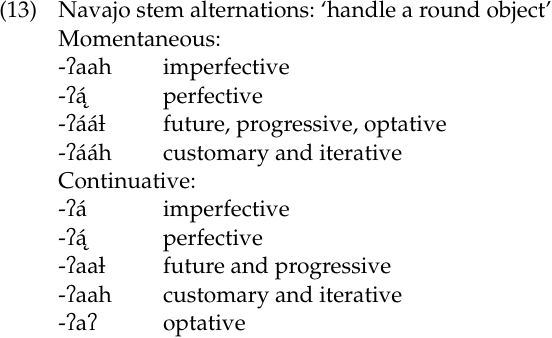
We see in (13) that there are four momentaneous stems for the verb ‘handle a round object’ and five for the continuative. The perfective stem is the same in the momentaneous and the continuative. The other stems are all different. In all, there are eight different forms of this one stem, which would interact with affixation to express the full range of verbal inflectional categories.








