Bounding
Langacker (2002: 65–9) raises a number of important points in relation to the notion of bounding. Firstly, bounding must be defined within rather than by the scope of predication or domain evoked by the expression. He illustrates this point with the visual example I see NP, which limits the scope of predication of the NP to whatever is contained within the speaker’s VISUAL FIELD. Langacker’s examples concern a scene in which the speaker is standing in front of a wall upon which a large red spot is painted against a white background. If the speaker is standing far enough from the wall to see both the red spot and the white back ground, the speaker will describe what he or she sees in the following way:
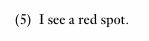
Observe that a red spot is a noun phrase (NP) with the count noun spot as its head. This is consistent with the fact that the red area is bounded within the field of vision (because the speaker can see the ‘edges’ of the red spot) which is equivalent to the scope of predication of the NP. Now imagine that the speaker approaches the wall and stands so close to it that the red spot fills the visual field. The speaker may now describe what he or she sees as follows:
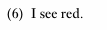
In this example, red is a mass noun, which is consistent with the fact that the red area is unbounded within the visual field of the speaker which is equivalent to the scope of predication of the NP. Crucially, in both scenarios, the red spot is bounded by the visual field in the sense that it is not experienced outside the visual field. However, this is not sufficient for the speaker to construe the red spot as bounded in both scenarios. Indeed, if this were the case, any noun relat ing to the domain of VISION would have to be bounded and therefore a count noun, which is clearly not the case. As this example illustrates, bounding must occur within the relevant domain.
Langacker’s second point concerning bounding is that it is does not necessarily entail sharp boundaries. In other words, while some count nouns like January or tummy button designate regions with sharp and clearly defined boundaries, others, like season or tummy, designate regions with fuzzy boundaries. This is consistent with the nature of categories in general, as we saw in Chapter 8.
Langacker’s third point is that bounding is often a function of construal rather than of objective reality. In other words, whether a region of a given domain is bounded or not sometimes depends on how we construe it rather than upon its inherent properties. Consider the examples in (7).

In example (7a), spot designates an area on the rug that has inherent boundaries perceived within the visual field. We know that if we spill something on a rug, the stain has ‘edges’. On the other hand, spot in (7b) does not designate an area with inherent or readily perceivable boundaries. Instead, bounding is imposed upon the area by construal.
Finally, Langacker observes that the term region must be defined as ‘a set of interconnected entities’ in order to account for count nouns like team, group, family and so on. This is because it is less straightforward to think of these as regions in the sense of having a clear ‘shape’ or in the sense that they occupy a distinct area of space from other categories. For example, you can think of your mum, dad, brother and sister as making up your FAMILY even when each of them is on a different continent. This illustrates the importance of interconnection to the notion of ‘region’. Given the discussion so far, Langacker (2002: 69) revises his schematic characterisation of the noun category that we saw in (4) as follows:

The modifier ‘specifically’ in (8b) relates to the fact that the nominal expression itself does not specify bounding, regardless of whether the mass evoked by the expression is bounded in reality. Consider the following examples:

As these examples demonstrate, the mass noun sand can be used to refer to a mass that has no boundaries imposed on it by the context, as in (9a). In this case, the result is generic construal, which means that the noun designates ‘sand in general’. However, mass nouns are often used to designate a mass that does have boundaries imposed on it by the context, as in (9b). In this context, Lily did not buy ‘sand in general’ but a specific amount, probably measured in sacks. The contrast between these two examples illustrates that the regions designated by mass nouns can be externally bounded. However, this does not affect their conception as unbounded masses.
As we saw in Chapter 15, however, unbounded masses can be construed as bounded masses, which is reflected in expressions like one sand and two cements. Langacker argues that bounding is only one parameter that distinguishes the regions designated by count and mass nouns. Other parameters include homogeneity versus heterogeneity, expansibility and contractibility, and replicability.








