الوضع الليلي


 10:51:37
  2026-02-21
  1748
1748
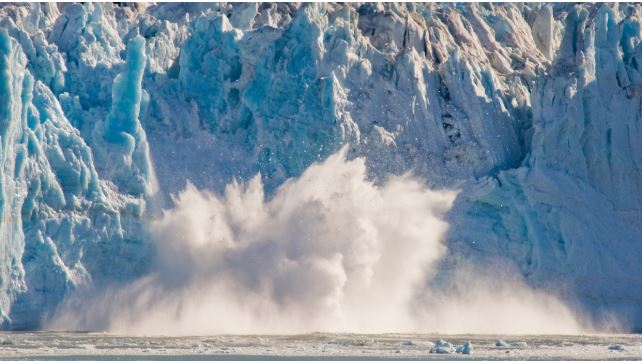
It's difficult to forget standing in front of a glacier that is advancing towards you, towering ice pillars constantly cracking as they inch forward. The motion is too slow to see in real time, but obvious from one day to the next.
One of us (Harold) experienced this during fieldwork in 2012 at Nathorstbreen on the Arctic archipelago of Svalbard, which was moving forwards more than 10 meters per day.
Encounters like this are rare. Most of the world's glaciers are retreating rapidly as the climate warms, and thousands are likely to disappear altogether within the next few decades.
However, a small fraction of glaciers do the opposite, and repeatedly speed up and advance for months or years after a long period of stagnation and retreat. This is known as glacier surging, and it has long puzzled scientists.
It might be tempting to view advancing ice as an antidote to the gloomy picture of disappearing glaciers, but the polar opposite is true. Surges can accelerate ice loss, make glaciers more vulnerable to climate change, and create serious hazards for people living downstream of them.
We have just published a global study of over 3,000 surging glaciers to find out what's causing them to move like this. Our work also summarises, for the first time, the hazards caused by these glaciers, and how surging is being affected by climate change.
Why some glaciers surge
During surges, glaciers accelerate from a slow crawl to tens of meters per day – sometimes within weeks. The fastest phase, when ice can flow at over 60 meters a day, typically lasts a year or more – although some glaciers have surged for up to 20 years. The return to low speeds and even stagnation can happen abruptly over days, or over several years.
Nathorstbreen dramatically advanced more than 15 kilometers in roughly a decade during its surge, which began in 2008 – transforming the entire landscape in a matter of years.
The onset of surging is thought to be controlled by changes beneath the glacier. In surge-type glaciers, water generated by melting ice does not immediately drain away, but gathers at the bottom of the glacier. This reduces friction between ice and the ground, making it easier for ice to slide faster.
When that water eventually drains, the glacier slows again. Some glaciers experience repeated surges separated by years or decades of low ice flow – but the exact timing of surges is hard to predict.
Global hotspots of surging ice
Our study shows that at least 3,000 glaciers have surged at some point. That's only about 1% of all glaciers in the world, but they tend to be large, so represent about 16% of the global glacier area.
Notably, they are found in dense geographical groupings across the Arctic, the Himalayas and other high mountains in Asia, and the Andes – but are largely absent elsewhere. This is primarily controlled by the climate: surges do not generally happen where conditions are currently too warm, such as in the European Alps or mainland Scandinavia, or too cold and dry, such as Antarctica.
Other factors such as size and underlying geology are also important for determining which glaciers surge in a region and which do not.
Some of the hotspots are found in populated regions, where surging glaciers can become hazards. The advancing ice can overrun infrastructure and farmland, and block rivers to form dangerous lakes that can release devastating floods when the ice breaks.
An unstable lake formed by a surge of Shisper Glacier in the Karakoram mountain range drained multiple times from 2019 to 2022, causing extensive damage to the Karakoram Highway, a key connection between Pakistan and China.
Fast-moving ice can cause deep cracks (crevasses) to form, affecting travel in regions such as Svalbard where glaciers provide highways between isolated human settlements. It also disrupts tourism and recreation activities, such as where climbers use glaciers to approach peaks. When glaciers surge into the sea, they release numerous icebergs in a short space of time that could present a risk to shipping and tourism.
Surging is changing as the climate warms
Climate warming is already reshaping how and when glaciers surge. In some regions, surges are becoming more frequent; in others, they are declining as glaciers thin and lose the mass needed to build towards a surge.
Heavy rainfall, intense melt periods or other extreme weather have also been shown to trigger earlier-than-expected surges, and these factors may become more important in a warming climate.
Together, this paints a picture of the increasing unpredictability of glacier surges. Some regions might experience less surging as the world warms, while others might see an increase. It is feasible that glaciers that have never surged before may begin to, including in areas where there are no records of past surges, such as the fast-warming Antarctic peninsula.
Reality Of Islam |
|

Keeping sil
Two experim

Changing a

Plants are
 9:3:43
2018-11-05
9:3:43
2018-11-05
10 benefits of Marriage in Islam
7:5:22
2019-04-08
benefits of reciting surat yunus, hud &
9:45:7
2018-12-24
advantages & disadvantages of divorce
11:35:12
2018-06-10
6:0:51
2018-10-16
8:4:21
2022-01-08
al-hussain (peace be upon him)
10:18:1
2022-09-21
a hero waters thirsty wild animals
9:4:9
2022-01-06
12:47:1
2022-12-20
4:25:57
2023-02-11
2:5:14
2023-01-28
7:45:39
2018-06-21
5:41:46
2023-03-18
| LATEST |
 HOME
HOME