الوضع الليلي


 10:49:27
  2026-02-18
  1644
1644
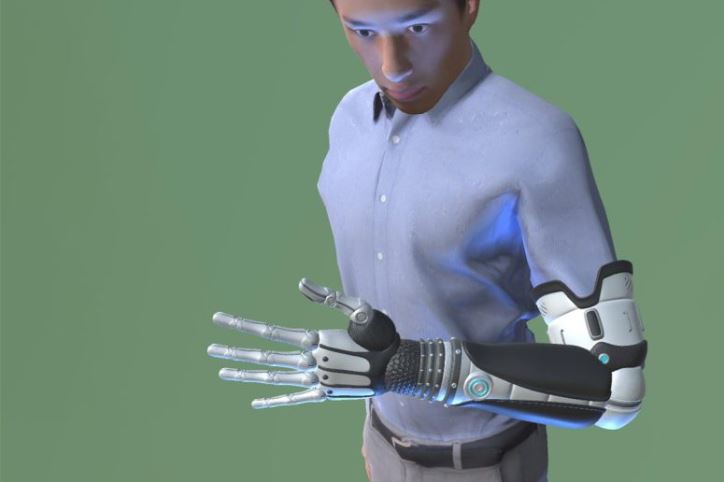
As AI-powered prosthetic arms become more advanced, a surprising detail could determine whether they truly feel like part of the body: how fast they move.
As artificial intelligence-powered prosthetic arms become more common, one key question stands out: Will people truly feel that these devices are part of their bodies? To explore this, researchers used virtual reality to create the illusion that a participant’s biological arm had been replaced with a robotic prosthetic. They then tested how the speed of the prosthetic’s movements influenced embodiment. This included feelings of body ownership, sense of agency, usability, and social perceptions such as competence and discomfort.
The results showed a clear pattern. When the robotic arm moved too quickly or too slowly, participants felt less connected to it and rated it as less usable. But when the arm moved at a moderate pace similar to a natural human reach, taking about one second to complete the motion, participants reported the strongest sense that it felt like their own arm.
From User Controlled Devices to Autonomous AI Prosthetics
For people who lose a hand or arm, prosthetic limbs are essential tools that restore independence in daily life. Much of the existing research has focused on improving how accurately these devices respond to a user’s intentions. This often involves translating biological signals such as electromyography (EMG) and electroencephalography (EEG) into movement.
At the same time, advances in machine learning and AI are opening the door to prosthetic limbs that can act on their own. Future systems may assess a situation and provide support through autonomous or semi-autonomous movement. However, when a limb moves independently, users may experience it as “unsettling” or “not part of my body.” That reaction poses a significant obstacle to widespread acceptance.
Virtual Reality Study on Movement Speed and Embodiment
Previous studies have suggested that people are more comfortable with autonomous movement when they understand the intention behind it. Building on this idea, Harin Manujaya Hapuarachchi and colleagues (Hapuarachchi was a doctoral student at the time of the study and is now an Assistant Professor in the School of Informatics at Kochi University of Technology) investigated whether movement speed itself influences acceptance.
Using virtual reality, the team presented participants with an avatar whose left forearm had been replaced by a prosthetic limb. Participants performed a reaching task while the virtual prosthetic arm moved automatically toward a target. The researchers varied how long the motion took across six different durations (125 ms to 4 s). After each condition, participants evaluated their sense of body ownership, control, usability (SUS), and their impressions of the robotic arm using a standardized scale (RoSAS: competence, warmth, and discomfort).
The One Second Sweet Spot
The findings were consistent:
These results suggest that simply making prosthetic arms faster and more precise is not enough. For AI-enabled prostheses that provide autonomous assistance, designers must consider movement timing that aligns with what the human brain naturally expects from a limb.
Implications for Robotic Body Augmentation
The implications extend beyond prosthetic arms. Other technologies that function as extensions of the body, including supernumerary robotic limbs, exoskeletons, and wearable robots, may also benefit from movement patterns that mirror natural human timing.
Researchers also plan to explore how long-term use affects perception. People often come to experience familiar tools as if they are part of their bodies. With continued daily use, even a fast and highly capable robotic limb could begin to feel “normal,” easier to operate, and more fully integrated into a person’s body image.
Virtual reality remains an important research tool in this process. It allows scientists to safely test emerging prosthetic technologies and control methods that are not yet widely available. This approach helps evaluate psychological responses, user acceptance, and design considerations before such devices are introduced into everyday life.
Reality Of Islam |
|
A study of
Researchers
MIT enginee
 9:3:43
2018-11-05
9:3:43
2018-11-05
10 benefits of Marriage in Islam
7:5:22
2019-04-08
benefits of reciting surat yunus, hud &
9:45:7
2018-12-24
advantages & disadvantages of divorce
11:35:12
2018-06-10
6:0:51
2018-10-16
5:57:34
2023-03-18
7:34:7
2023-02-28
9:39:36
2022-12-28
1:34:8
2022-02-01
2:42:26
2023-02-02
2:5:14
2023-01-28
12:10:56
2022-11-17
5:41:46
2023-03-18
| LATEST |
 HOME
HOME