الوضع الليلي


 7:52:42
  2026-02-04
  1947
1947
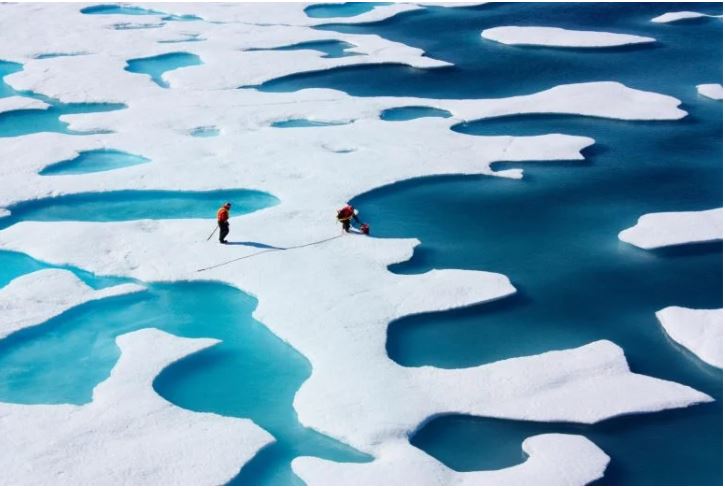
Arctic sea ice plays a powerful role in regulating Earth’s climate. By reflecting sunlight and cooling the planet, it helps shape ocean currents, atmospheric circulation, and extreme weather patterns far beyond the polar regions. As climate change accelerates the loss of this ice, scientists increasingly rely on real-time tracking of sea ice extent (SIE) — the area of water with a minimum concentration of sea ice — to assess the health of the Arctic ice system.
A New Way to Predict September Sea Ice
Reporting today (February 3) in Chaos, published by AIP Publishing, a research team from the United States and the United Kingdom described a method that delivers accurate, real-time predictions of Arctic SIE. Their work focuses on September, when Arctic Sea ice reaches its annual minimum, making it a key benchmark for understanding long-term ice decline.
Why Accurate Ice Forecasts Matter
“Indigenous Arctic communities depend on the hunting of species like polar bears, seals, and walruses, for which sea ice provides essential habitat,” said author Dimitri Kondrashov. “There are other economic activities, such as gas and oil drilling, fishing, and tourism, where advance knowledge of accurate ice conditions reduces risks and costs.”
Reliable sea ice forecasts can help communities and industries plan ahead in a rapidly changing Arctic environment.
How the Prediction Model Works
Instead of treating sea ice change as a single process, the researchers modeled it as the result of multiple interacting forces that operate on different timescales. These include long-term climate memory, regular seasonal patterns, and fast-changing weather conditions. To identify how these factors influence one another, the team analyzed average daily SIE data from the National Snow and Ice Data Center dating back to 1978.
Tested in Real Time and Against the Past
The researchers tested their model both in real time during September 2024 and by applying it to September data from previous years. The results showed that the method reliably captured changes ranging from subseasonal to seasonal timescales. When forecasting SIE one to four months in advance, the model consistently performed better than existing prediction approaches.
Improving Short-Term Arctic Forecasts
Long-range climate projections are generally more stable than short-term forecasts, which are often disrupted by rapidly changing weather. By integrating detailed regional information into their model, the researchers were able to significantly improve short-term predictions of sea ice and related weather patterns.
“The model includes several large Arctic regions composing [the] pan-Arctic,” said Kondrashov. “Despite large differences in sea ice conditions from year to year in different regions, the model can pick it up reasonably accurately.”
What Comes Next for Arctic Sea Ice Prediction
The team plans to refine the model further by adding more atmospheric and oceanic variables, including air temperature and sea level pressure. These factors can drive rapid changes and short-term fluctuations that are not yet fully captured. The researchers expect that incorporating them will lead to even more reliable predictions of Arctic Sea ice during the summer months.
Reality Of Islam |
|

Keeping sil

Two experim

Changing a
Plants are
 9:3:43
2018-11-05
9:3:43
2018-11-05
10 benefits of Marriage in Islam
7:5:22
2019-04-08
benefits of reciting surat yunus, hud &
9:45:7
2018-12-24
advantages & disadvantages of divorce
11:35:12
2018-06-10
6:0:51
2018-10-16
6:0:8
2023-03-19
9:30:2
2021-11-12
6:14:3
2023-01-18
bahlool & the throne of haroun rashid
8:20:35
2018-06-21
2:11:12
2022-10-15
12:47:1
2022-12-20
a hero waters thirsty wild animals
9:4:9
2022-01-06
5:41:46
2023-03-18
| LATEST |
 HOME
HOME