الوضع الليلي


 11:4:10
  2026-01-11
  2098
2098
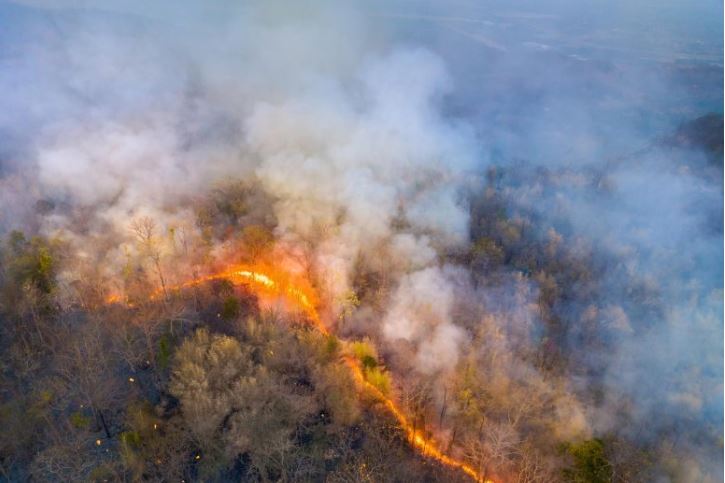
These hidden emissions can form fine particles that worsen air quality, especially in regions already burdened by human pollution.
As fires move across forests, grasslands, and peatlands, they release clouds of gases and particles into the atmosphere. Scientists now believe this pollution has been underestimated. A new study published in the American Chemical Society’s Environmental Science & Technology finds that wildfires and prescribed burns (i.e., wildland fires) worldwide may emit far more pollution-related gases than earlier estimates suggested. The analysis also points to regions where wildfire smoke overlaps with heavy human emissions, creating especially complicated air quality problems.
Wildfire emissions higher than expected
“Our new estimates increase the organic compound emissions from wildland fires by about 21%,” says Lyuyin Huang, the first author of the study. “The inventory provides a foundation for more detailed air-quality modeling, health-risk assessment, and climate-related policy analysis.”
Every year, wildfires burn vast areas of vegetation, sending a mixture of water vapor, ash, and carbon-based chemicals into the air. Some of these chemicals are volatile organic compounds (VOCs), which readily exist as gases. Others only become gases at warmer temperatures and are classified as intermediate- and semi-volatile organic compounds (IVOCs and SVOCs, respectively). Once airborne, these partially volatile compounds can more easily form fine particles — pollutants that can be harmful if breathed in — than VOCs.
The missing chemicals in wildfire smoke
Despite their importance, IVOCs and SVOCs are often left out of wildfire emission studies. Their sheer number and chemical diversity make them difficult to measure, leading many previous assessments to focus mainly on VOCs. Researchers led by Shuxiao Wang set out to include these overlooked compounds to better understand how wildland fires affect air quality, human health, and climate.
To do this, the team first examined global records of burned land from forest, grass, and peatland wildland fires between 1997 and 2023. They then gathered data on the types and amounts of VOCs, IVOCs, SVOCs, and other extremely low volatility organic compounds released as different vegetation types burn. When real-world measurements were unavailable, the researchers used laboratory experiments to estimate the chemicals produced. By combining these sources, they calculated annual wildfire emissions around the globe.
Global totals and pollution hotspots
The results suggest that wildland fires release an average of 143 million tons of airborne organic compounds each year. That figure is about 21% higher than earlier estimates, indicating that IVOCs and SVOCs play a much larger role in wildfire pollution than previously recognized.
When the team compared wildfire emissions with their earlier estimates of pollution from human activities, they found that human sources still produced more airborne compounds overall. However, both sources released similar amounts of IVOCs and SVOCs. The comparison also revealed several shared pollution hotspots, including Equatorial Asia, Northern Hemisphere Africa, and Southeast Asia. According to the researchers, these areas face especially complex air quality challenges and will need different strategies to address pollution from both fires and human activities.
Reality Of Islam |
|

Keeping sil
Two experim
Changing a
Plants are
 9:3:43
2018-11-05
9:3:43
2018-11-05
10 benefits of Marriage in Islam
7:5:22
2019-04-08
benefits of reciting surat yunus, hud &
9:45:7
2018-12-24
advantages & disadvantages of divorce
11:35:12
2018-06-10
6:0:51
2018-10-16
1:38:41
2021-12-08
7:59:14
2018-06-21
10:55:53
2022-06-13
6:0:8
2023-03-19
a hero waters thirsty wild animals
9:4:9
2022-01-06
the happy life of mankind requirement
6:36:36
2022-01-25
11:34:48
2022-06-29
5:41:46
2023-03-18
| LATEST |
 HOME
HOME