الوضع الليلي


 8:0:18
  2026-04-29
  1304
1304
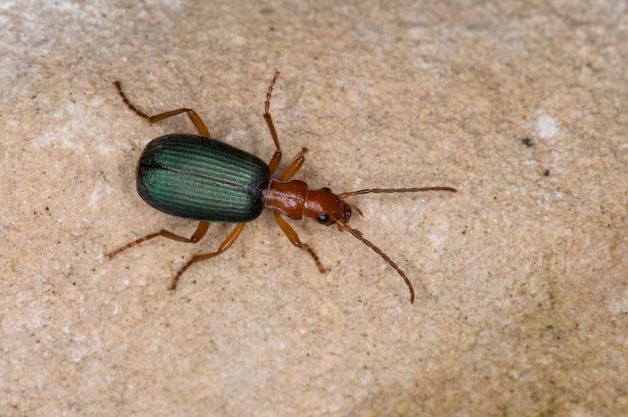
Bombardier beetles have the infamous ability to synthesize and release rapid bursts of stinky, burning-hot liquid from their rear ends. These noxious emissions can kill other insects, or startle potential predators into backing off.
These chemical “bombs” are the source of their name: Bombardier beetles.
But there’s not just one type. In fact, there are over 500 species of bombardier beetles around the planet, many in the genus Brachinus, and more than 40 species in the United States alone.
(Beetle larva lures and kills frogs, while the adult hunts and paralyses them)
They live in many different ecosystems, from forests to grasslands to deserts. Most are around the size of a fingernail, and many have dark-colored abdomens with reddish legs, heads, and antennae.
Secret weapon
Bombardier emissions range from slow secretions to rapid bursts, hot enough to burn and stain human skin. Their caustic defenses irritate the eyes and respiratory system of predators, often inflicting painful but temporary incapacitation.
Sometimes, their explosive emissions can even save their lives once they've been swallowed. Frogs, for example, have been known to regurgitate bombardiers after realizing the insects weren’t exactly palatable.
Creating a boiling-hot chemical bomb inside your body is no easy task. These tiny beetles rely on an elaborate internal network of reservoirs and chambers to synthesize their blasts safely.
The beetle’s explosive power is derived primarily from the mixture of two chemical compounds—hydroquinone and hydrogen peroxide—that are stored in separate reservoirs in the abdomen. The chemicals then pass through a valve before meeting in a special chamber, along with an enzyme that catalyzes the reaction. This creates gases that rapidly expand and give off heat.
(Beetle larva lures and kills frogs, while the adult hunts and paralyses them)
Beetles can open and close valves to this reaction chamber rapidly, fast enough to produce up to 500 explosive bursts in a second. These insects can also aim the chemical sprays at prey, using their rear ends like a noxious water pistol.
An evolutionary puzzle
The bombardier beetle has fascinated many, including Charles Darwin, who reported that one of them fired “acid” into his mouth—apparently he placed one in his teeth, unaware of its noxious emissions, while reaching for another specimen in the field. But the insects have also interested creationists, who’ve argued that this complex ability can’t be explained by Darwin's famous theory of evolution.
Biologists, however, maintain the beetle’s explosive emissions likely evolved incrementally. They theorize that the enzyme that allows the two chemical precursors to react started out weaker but became more specialized and effective over time, as has been shown to happen with other catalytic enzymes.
Like other winged insects, beetles can fly away from danger—but unlike bees or dragonflies, beetles’ wings are tucked under rigid shell covers and need to be unfurled before flight, which is not instantaneous. If the bombardier beetle’s chemical cannon is not enough to immediately repel predators, it can still buy precious time for them to flee.
Scientists have tried to untangle the internal chemistry of bombardier beetles for decades. Because the beetle’s spray contains chemicals called benzoquinones, the prevailing hypothesis was that these beetles may use hydroquinones—the building blocks of the beetle’s shell—to biosynthesize the ingredients necessary for their explosive secretions. But a study published in May 2020 confirmed that one raw chemical ingredient was unexpectedly derived from an entirely different pathway, synthesized from m-cresol, the same corrosive compound found in coal tar.
Life cycle and diet
During mating, the male beetle deposits a sack of sperm into the female’s reproductive tract, where the eggs are fertilized. Though choices can differ by species, female bombardier beetles often lay their eggs in decaying, moist vegetation, where their worm-like larvae hatch.
The larvae go through a series of molts as they grow, before reaching their final adult stage. As adults they only survive for a few weeks, and generally prefer feeding on young insects, but they will also scavenge on detritus. Bombardier beetles can navigate and hunt prey using a combination of eyesight and touch, relying on their antennae and sensitive hairs along their body to pick up vibrations.
Ecologically, they function as both predators and scavengers, but by eating detritus they also help decompose decaying vegetation. Many bombardier species prefer moist micro-environments and can often be found under logs and in leaf litter.
All bombardier beetles are in one of two subfamilies of ground beetles called Brachininae and Paussinae, with more than 50 genera combined.
Bombardier beetles have not been evaluated for their conservation status, and they are generally not considered vulnerable to extinction. The beetle order, Coleoptera, is the most diverse in the insect world, with more than 350,000 species.
Reality Of Islam |
|
For more th

A new polym

A tiny chip

Researchers
 9:3:43
2018-11-05
9:3:43
2018-11-05
10 benefits of Marriage in Islam
7:5:22
2019-04-08
benefits of reciting surat yunus, hud &
9:45:7
2018-12-24
advantages & disadvantages of divorce
11:35:12
2018-06-10
6:0:51
2018-10-16
8:15:37
2023-02-16
7:59:14
2018-06-21
9:42:16
2022-10-19
2:11:12
2022-10-15
1:34:8
2022-02-01
2:33:4
2023-02-15
8:39:51
2022-09-23
5:41:46
2023-03-18
| LATEST |
 HOME
HOME