الوضع الليلي


 12:38:30
  2025-04-28
  2102
2102
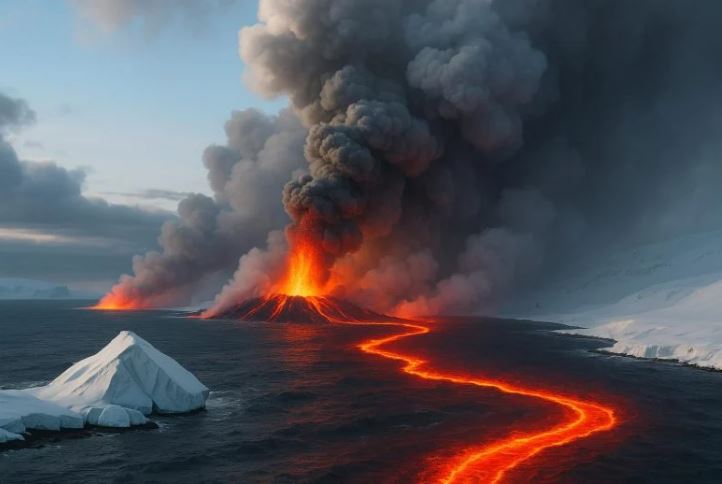
Chinese researchers traced 2023 Icelandic volcanic emissions to Arctic smog, showing 80% of Ny-Ålesund’s sulfur dioxide came from the eruption.
A research team led by Professors Si Fuqi and Yuhan Luo at the Hefei Institutes of Physical Science, part of the Chinese Academy of Science, has discovered compelling evidence of cross-border air pollution reaching the Arctic.
Their findings trace this pollution back to the 2023 eruption of Iceland’s Sundhnukagigar volcano. By integrating advanced satellite observations with ground-based monitoring, the team tracked sulfur dioxide (SO₂) emissions that traveled more than 2,000 kilometers (1250 miles) to the Svalbard Islands. These emissions led to significant smog conditions in the Arctic region.
The study was published in The Innovation Geoscience.
“Our study highlights the far-reaching impact of volcanic eruptions on the environment,” explained Kaili Wu, a member of the team, “It’s far beyond the immediate vicinity.”
Volcanic eruptions act like “chemical spray bombs,” spewing millions of tons of gases like sulfur dioxide into the atmosphere. These gases can transform into sulfate particles that contribute to acid rain and reflect sunlight, potentially causing global cooling. But fine volcanic ash particles, less than 2.5 microns in diameter, can penetrate deep into the lungs and trigger respiratory problems in humans.
Advanced Monitoring Tools Enable New Insights
The research team relied on advanced tools like the Environmental Trace Gases Monitoring Instrument, which is installed on two Chinese satellites. These satellites provide global daily scans, tracking pollutants with impressive precision. In addition to satellite data, the team also used measurements from China’s Yellow River Station in the Arctic, the only continuous atmospheric monitoring station in the region. This station tracks gases like sulfur dioxide, ozone, and bromine oxide, offering invaluable vertical profile data.
Their findings were striking: 80% of the sulfur dioxide pollution in Ny-Ålesund, a remote Arctic region, was traced directly to the volcanic eruption in Iceland. By combining satellite observation with ground-based measurements, the researchers created a detailed map of how the pollution traveled, providing insights into the source and impact of the eruption’s emissions.
The work paves the way for more precise, real-time environmental monitoring and response, protecting ecosystems and human health worldwide, according to the team.
Reality Of Islam |
|
For more th

A new polym

A tiny chip

Researchers
 9:3:43
2018-11-05
9:3:43
2018-11-05
10 benefits of Marriage in Islam
7:5:22
2019-04-08
benefits of reciting surat yunus, hud &
9:45:7
2018-12-24
advantages & disadvantages of divorce
11:35:12
2018-06-10
6:0:51
2018-10-16
2:2:13
2022-10-08
4:25:57
2023-02-11
5:58:12
2021-12-18
7:45:39
2018-06-21
7:6:7
2022-03-21
6:28:21
2022-12-20
the happy life of mankind requirement
6:36:36
2022-01-25
5:41:46
2023-03-18
| LATEST |
 HOME
HOME