الوضع الليلي


 11:34:51
  2025-02-24
  1936
1936
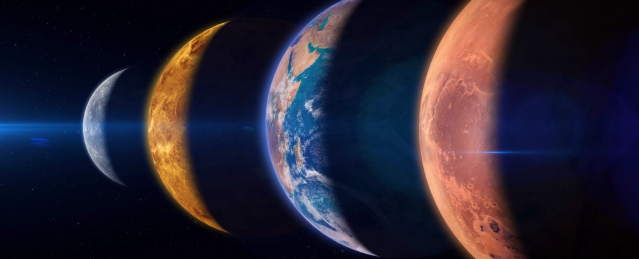
A very rare treat is about to grace Earth's night skies.
On the evening of 28 February 2025, all seven of the other planets in the Solar System will appear in the night sky at the same time, with Saturn, Mercury, Neptune, Venus, Uranus, Jupiter, and Mars all lining up in a neat row – a magnificent sky feast for the eyes known as a great planetary alignment.
It's not uncommon for a few planets to be on the same side of the Sun at the same time, but it's less common for most, or even all of the planets to align like this.
Any number of planets from three to eight constitutes an alignment. Five or six planets assembling is known as a large alignment, with five-planet alignments significantly more frequent than six.
Seven-planet great alignments are, of course, the rarest of all.
These alignments aren't the neat planetary queues you see in diagrams and illustrations of the Solar System. That's not a thing that actually happens in the real Universe, sadly.
Yet the planets do appear to arrange themselves along an imaginary line.
This occurs because the planets of the Solar System all orbit the Sun on a flat plane called the ecliptic. Some of the planets have orbits tilted slightly above or below this plane, but they're all more or less on the same level like grooves on a record thanks to the way stars like our Sun form.
A baby star in a cloud of material starts spinning; the cloud around them swirls into a flattish disk that feeds into the baby star around its equator.
Planets form from what remains of the disk and, if left uninterrupted by other gravitational influences, will remain orbiting in that level position.
Occasionally, the planets will be on the same side of the Sun as they move along their orbits, so we get to see them in the sky at the same time. This is what will grace the sky on the evening of February 28.
How to watch
Whether you will be able to see the alignments, at what time the planets rise and set, and in which order, depends on where in the world you're viewing from.
There are tools you can access to get those times and sky locations.
Time and Date has an interactive tool that allows you to set the date you want to view, showing the rise and set times for each planet, where in the sky they can be seen, and how difficult they will be to see.
Stellarium has a similar web tool that shows you the positions of all the planets.
Sky Tonight is a free mobile app that uses your phone's hardware to gauge where you are located, and shows you real-time positions of celestial objects on a map of the sky above. There is a good list of other options here, too.
You will need some binoculars or a telescope to see the planets in all their glory, so if you haven't already, start planning now. And keep your fingers crossed for clear skies!
Reality Of Islam |
|

A study of

Researchers

MIT enginee
 9:3:43
2018-11-05
9:3:43
2018-11-05
10 benefits of Marriage in Islam
7:5:22
2019-04-08
benefits of reciting surat yunus, hud &
9:45:7
2018-12-24
advantages & disadvantages of divorce
11:35:12
2018-06-10
6:0:51
2018-10-16
a hero waters thirsty wild animals
9:4:9
2022-01-06
9:30:2
2021-11-12
4:2:19
2022-10-10
al-hussain (peace be upon him)
10:18:1
2022-09-21
6:28:21
2022-12-20
9:42:16
2022-10-19
2:2:13
2022-10-08
5:41:46
2023-03-18
| LATEST |
 HOME
HOME