الوضع الليلي


 2:46:55
  2024-09-18
  2178
2178
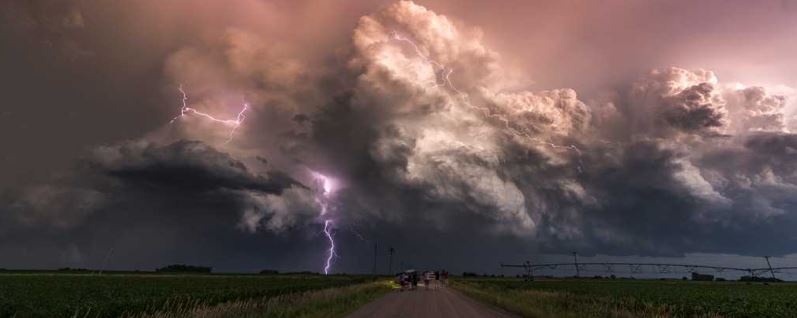
Human-driven changes to the natural environment have knock-on consequences that aren't immediately obvious: air pollution, for example, has now been linked to an increase in the frequency of lighting in thunderstorms.
Researchers from James Madison University (JMU) in Virginia looked at data from more than 500,000 thunderstorms across Washington, DC, and Kansas City over the course of 12 years, finding that having more fine particles in the air (aerosols) is broadly linked to a higher number of lighting strikes.
The relationship between aerosols and lightning has been studied befor, but it's something that scientists are still trying to get a proper assessment of, because of the many different atmospheric factors at play.
"Pollution acts as cloud nuclei," says geographer Mace Bentley, from JMU.
"It gets brought into the cloud through the updraft; the updraft and downdraft then separate the pollution particles, which divides the electrical charges in the cloud and leads to more lightning production."
The team looked at PM2.5 (particulate matter up to 2.5 micrometers) and PM10 (up to 10 micrometers) in the environment, comparing them to thunderstorm activity. It seems that the concentration of these particles has more of an influence than their size.
While more particles generally means more lightning, according to the data, there comes a point where having too many particles in the air actually seems to reduce the amount of lighting – perhaps due to a loss of energy inside the storm.
These are scenarios with a huge number of variables – and multiple other factors, from air currents to land cover, also play a part. That said, while the associations outlined here are complex, they seemed to be the same in both cities studied.
"It looks like no matter where you go in the world, urban pollution is capable of enhancing thunderstorms and lightning," says Bentley.
The study turned up some other interesting findings too: thunderstorms were most common in both locations on Thursdays. Monday was the quietest day for thunderstorms in Washington, DC, while it was Friday for Kansas City.
It was also observed that when there was most energy in the atmosphere – influenced by factors such as temperature and humidity – then the levels of air pollution had the most impact on the number of lighting strikes.
This gives us a greater understanding of how fluctuations in air pollution might continue to reshape meteorological patterns. Next, the researchers want to take a look at this relationship in other parts of the world, while also adding more measurements to the mix to see just how much of an effect aerosols are having.
"The environments will be analyzed for differences between urban initiated thunderstorms versus those across the greater region to evaluate the impacts of pollution," write the authors in their published paper.
Reality Of Islam |
|

Plants are

After spend

A study of

Researchers
 9:3:43
2018-11-05
9:3:43
2018-11-05
10 benefits of Marriage in Islam
7:5:22
2019-04-08
benefits of reciting surat yunus, hud &
9:45:7
2018-12-24
advantages & disadvantages of divorce
11:35:12
2018-06-10
6:0:51
2018-10-16
10:55:53
2022-06-13
10:43:56
2022-06-22
11:34:48
2022-06-29
5:58:12
2021-12-18
9:42:16
2022-10-19
9:50:37
2023-02-28
7:34:7
2023-02-28
5:41:46
2023-03-18
| LATEST |
 HOME
HOME