الوضع الليلي


 7:24:50
  2019-11-13
  1884
1884
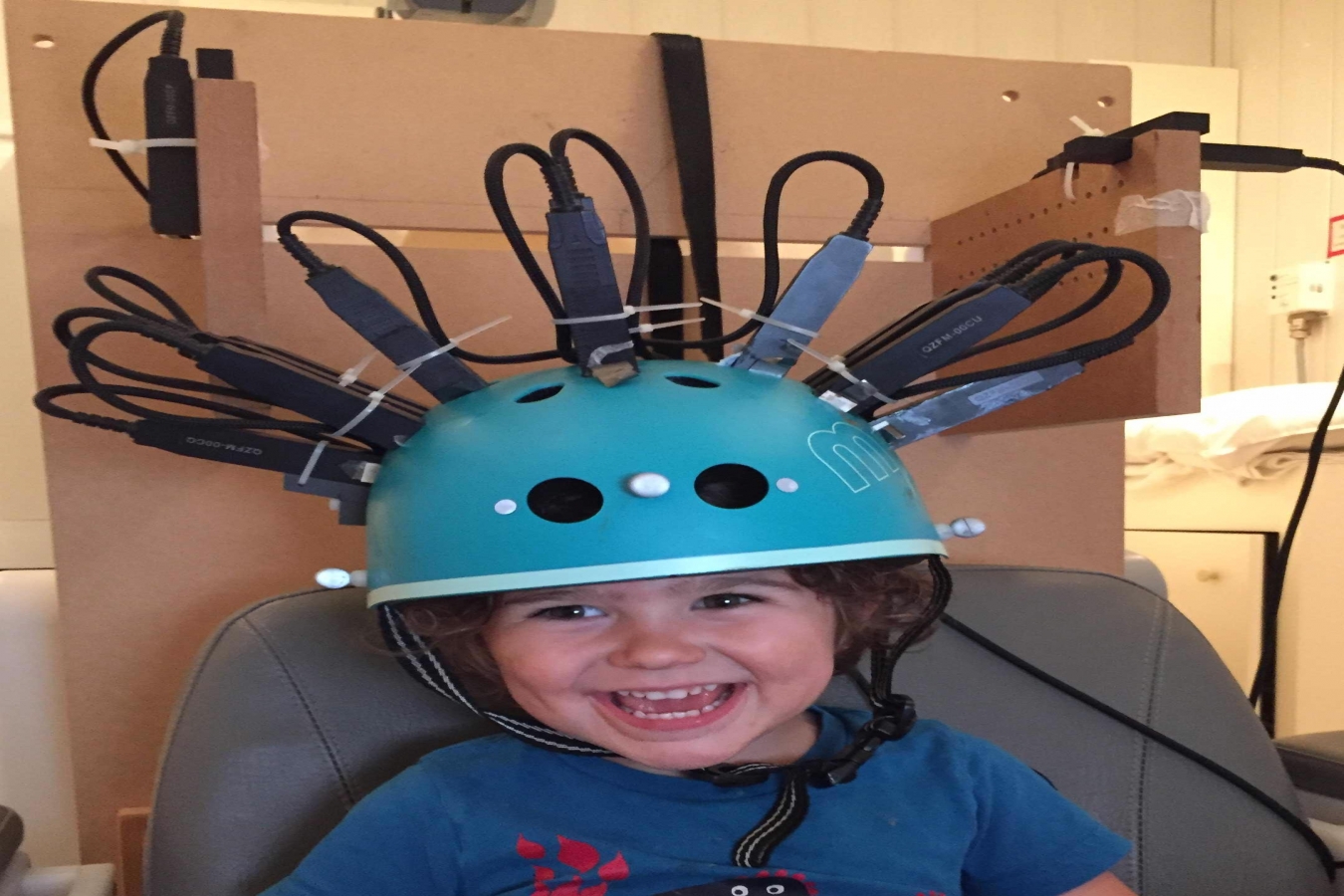
As kids grow, their brains undergo a development process that is poorly understood. Children can have short attention spans, move around a lot, and are not easy to get into and then keep still inside a stationary scanner.
Now, a collaboration of scientists from University of Nottingham, University of Oxford, and University College London has developed a functional magnetoencephalography scanner that young kids can wear while playing video games and doing other normal activities. Using the technology, it may be possible to better understand how a variety of brain conditions develop. Of course, there may also be diagnostic possibilities when looking for autism, ADHD, and other diseases.
Magnetoencephalography measures the magnetic fields that excitable cells, such as neurons, generate when electric current passes through them. This provides a view into the regional brain, so when the subject moves arms and hands, the activity in the motor cortex can be seen.
Most magnetometers used in magnetoencephalography are very heavy and rigid machines called superconducting quantum interference devices. The British team used recently developed optically pumped magnetometer technology to reduce the helmet to about a pound (500 grams) in weight.
Optically pumped magnetometers don’t require extremely low temperatures, and so can be placed much closer to the head, resulting in a higher quality signal. Additionally, the special room where this has to be performed, has walls with a conductive pattern that is used to actively normalize the surrounding magnetic field.
The technology may answer a lot of questions about brain development and perhaps lead to novel therapies for common neurological diseases.
Some details about the technology according to the open access study in Nature Communications:
Traditional (superconducting) MEG sensors require cooling inside a large cryogenic dewar, meaning systems cannot adapt to head shape/size and require participants to keep still during data acquisition. However, recently developed optically pumped magnetometers (OPMs) offer a means to measure the small magnetic fields generated by the brain; they are small and lightweight, and can be positioned flexibly on the scalp surface. This means that an OPM-MEG system can be adapted to any head shape/size. Furthermore, if background magnetic fields are appropriately nulled, OPMs can be mounted on the head and participants can move during scanning.
Reality Of Islam |
|

After spend

A study of

Researchers
 9:3:43
2018-11-05
9:3:43
2018-11-05
10 benefits of Marriage in Islam
7:5:22
2019-04-08
benefits of reciting surat yunus, hud &
9:45:7
2018-12-24
advantages & disadvantages of divorce
11:35:12
2018-06-10
6:0:51
2018-10-16
2:2:13
2022-10-08
8:19:41
2018-06-21
1:16:44
2018-05-14
8:4:21
2022-01-08
7:6:7
2022-03-21
4:2:19
2022-10-10
7:26:19
2022-04-08
5:41:46
2023-03-18
| LATEST |
 HOME
HOME