الوضع الليلي


 12:56:44
  2025-04-20
  1969
1969

Researchers at POSTECH identified a new battery degradation mechanism triggered by deep discharging. Avoiding full discharge significantly extends the life of high-nickel lithium-ion batteries.
A research team led by Professor Jihyun Hong from the Department of Battery Engineering at POSTECH (Pohang University of Science and Technology), in collaboration with Professor Jongsoon Kim’s group at Sungkyunkwan University, has uncovered a previously unidentified degradation mechanism in lithium-ion batteries. The team includes researchers Seungyun Jeon and Dr. Gukhyun Lim. Their groundbreaking work has been featured as the cover article in Advanced Energy Materials.
Lithium-ion batteries, widely used in electric vehicles, commonly employ nickel-manganese-cobalt (NMC) ternary cathodes. To lower production costs, the industry has increasingly shifted toward using cathodes with higher nickel content while reducing the proportion of costly cobalt. However, this approach often comes at the expense of battery longevity, as elevated nickel levels are known to reduce the overall cycle life.
A Focus on the Discharging Process
Until now, battery performance degradation was primarily attributed to overcharging. However, this explanation failed to account for degradation occurring under seemingly stable voltage conditions. The research team focused on the discharging process—the actual operation of the battery—to solve this mystery.
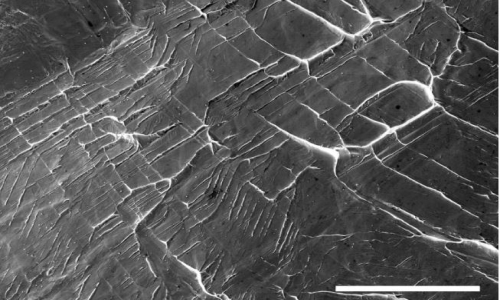
They discovered that when a battery is used for extended periods without recharging, a phenomenon known as the “quasi-conversion reaction” occurs on the cathode surface. During this reaction, oxygen escapes from the surface and combines with lithium to form lithium oxide (Li₂O) during discharge, particularly around 3.0V. This compound further reacts with the electrolyte, generating gas and accelerating battery degradation.
The quasi-conversion reaction was found to be more severe in high nickel cathodes. The research team confirmed that when batteries are used until most of their capacity is depleted, the effects of the degradation process including battery swelling, become increasingly pronounced.
A Simple Strategy to Prolong Battery Life
Importantly, the study also revealed a simple yet effective solution. The research team significantly extended cycle life by optimizing battery usage and avoiding full discharge. In experiments with high-nickel batteries (containing over 90% nickel), those discharged deep enough to trigger the quasi-conversion reaction retained only 3.8% of their capacity after 250 cycles, whereas batteries with controlled usage maintained 73.4% of their capacity even after 300 cycles.
Prof. Jihyun Hong, who led the research, stated, “The impact of discharge—the actual process of using a battery—has been largely overlooked until now,” and added, “This research presents an important direction for the developing longer-lasting batteries.”
Reality Of Islam |
|

Keeping sil
Two experim

Changing a

Plants are
 9:3:43
2018-11-05
9:3:43
2018-11-05
10 benefits of Marriage in Islam
7:5:22
2019-04-08
benefits of reciting surat yunus, hud &
9:45:7
2018-12-24
advantages & disadvantages of divorce
11:35:12
2018-06-10
6:0:51
2018-10-16
8:30:23
2022-03-03
10:43:56
2022-06-22
7:0:55
2022-05-17
8:21:9
2018-06-21
2:2:13
2022-10-08
9:42:16
2022-10-19
2:34:48
2022-01-18
5:41:46
2023-03-18
| LATEST |
 HOME
HOME