الوضع الليلي


 11:13:2
  2025-01-19
  2051
2051
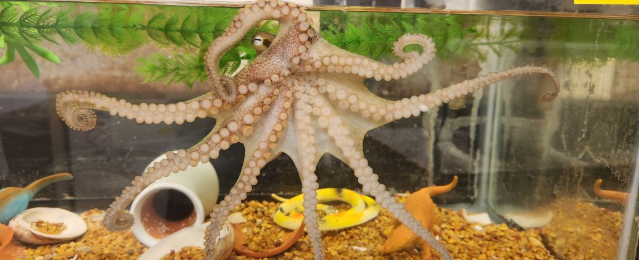
Octopuses tend to keep secrets, but we've just learnt how they achieve their extraordinary dexterity.
The fine control these almost-alien animals have over each of their eight arms is at least partially down to the segmentation of the nervous system circuitry that governs it. This discovery by researchers at the University of Chicago helps us understand the strange way cephalopods navigate the world, and may even inform future designs for soft robots.
"If you're going to have a nervous system that's controlling such dynamic movement, that's a good way to set it up," says neurobiologist Clifton Ragsdale. "We think it's a feature that specifically evolved in soft-bodied cephalopods with suckers to carry out these worm-like movements."
The octopus nervous system is among the most unusual on Earth. Unlike in other intelligent animals, it's highly distributed, with a significant proportion of its 500 million-odd neurons spread throughout the eight arms. In fact, more neurons reside in the arms than in the octopus's head.
Their arms are capable of making decisions independently and can even continue to react to stimuli after being severed. Each has more degrees of freedom than we can count, and any of its hundreds of suckers, able to “taste” the chemistry of the octopus's environment, is able to change shape independently.
The neurons in the octopus's arms are concentrated along an axial nerve cord that undulates down the length of each arm, with nodes centered around each of the suckers. It seems complex and focused, and a team led by neuroscientist Cassady Olsen wanted to study it in detail to see if they could learn more about how it functions.
When they put longitudinal slices of arm from the California two-spot octopus (Octopus bimaculoides) under the microscope, they found something that they had never seen before. Along the axial nerve cord, the neuronal cells are packed into segments, separated by gaps called septa, rich with connective tissue, where the nerves and veins exit to connect to muscles nearby.
Following these connections, the researchers found that nerves from multiple segments connect to different muscle regions – suggesting that the segments work together to control the muscles with a high degree of precision.
They found that the nerves for the suckers also connect via the septa, creating a sort of nervous spatial map of the suckers, and allowing for the fine, individual control of each one as the octopus uses them to sense its environment through touch-tasting.
"Thinking about this from a modeling perspective, the best way to set up a control system for this very long, flexible arm would be to divide it into segments," Olson says. "There has to be some sort of communication between the segments, which you can imagine would help smooth out the movements."
The next step was to try to figure out the relationship between the segmentation of the axial nerve cord and its function by looking for similar architecture in another group of cephalopods: squids.
Squids and octopuses use their limbs differently: octopuses to explore, move across the seafloor, and manipulate objects, while squids use theirs in open water to grab and hold prey.
The researchers found that the architecture of the axial nerve cord in the longfin inshore squid (Doryteuthis pealeii) is quite different from that of octopuses. In addition, there was no segmentation in the suckerless stalks of the tentacles – but nerve segmentation was found in the suckered clubs.
The finding suggests that a segmented nervous system is related to the control of suckered appendages, and is crucial to fine, dextrous control. Squids probably don't need as many segments because they don't use their suckers for exploration the way octopuses do.
"Organisms with these sucker-laden appendages that have worm-like movements need the right kind of nervous system," Ragsdale says. "Different cephalopods have come up with a segmental structure, the details of which vary according to the demands of their environments and the pressures of hundreds of millions of years of evolution."
Reality Of Islam |
|
Keeping sil
Two experim
Changing a
Plants are
 9:3:43
2018-11-05
9:3:43
2018-11-05
10 benefits of Marriage in Islam
7:5:22
2019-04-08
benefits of reciting surat yunus, hud &
9:45:7
2018-12-24
advantages & disadvantages of divorce
11:35:12
2018-06-10
6:0:51
2018-10-16
4:2:19
2022-10-10
2:5:14
2023-01-28
8:3:0
2018-06-21
11:2:27
2022-10-06
6:14:17
2018-06-21
10:43:56
2022-06-22
allah will not answer all your prayers
6:56:28
2022-01-01
5:41:46
2023-03-18
| LATEST |
 HOME
HOME