الوضع الليلي


 2:52:20
  2024-07-24
  2236
2236
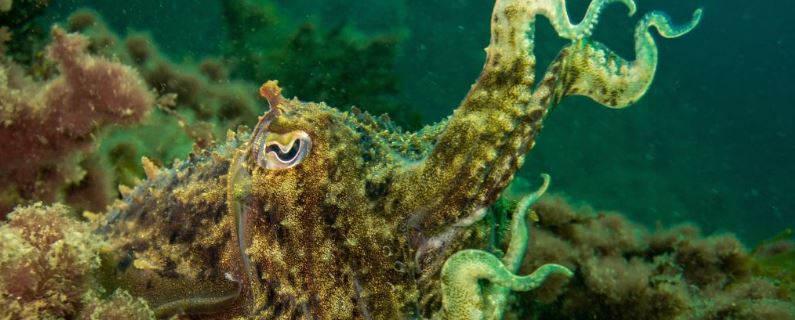
Our memory, for all the good it does us, can also tell us lies.
Thanks to the piecemeal way our brain stores memory information, aspects of our recollections can become jumbled as we reconstruct them, leading to the generation of what are called false memories.
Now, for the first time, evidence of false memories has been seen in the common cuttlefish, a creature that couldn't be more different from humans.
It's a clue that could help us better understand the powerful, strange intelligence evinced, not just by cuttlefish (Sepia officinalis), but by its close cephalopod relatives, such as octopuses and, to a lesser extent, squids.
"Our results suggest that cuttlefish do form visual false memories, but not olfactory false memories," write a team led by neuroethologist Lisa Poncet of the University of Caen Normandy in France. "These memory errors might be the first indication of the presence of reconstructive processes in the memory of cephalopods."
In past experiments, cuttlefish have shown some pretty jaw-dropping evidence of intelligence, including passing a cognitive test designed for human children that assess their ability to delay gratification. They can also be trained to recognize shapes and associate those shapes with specific treats.
And, relevant to today's news, they have demonstrated very sharp, specific, and detailed memory recall. These strange marine animals can recall what they ate, where they ate it, and when it was eaten; a level of detail known as episodic memory.
What Poncet and her colleagues wanted to know is how those memories are recalled – whether they emerge from the brain in one smooth go, or whether, like humans, the cuttlefish brain needs to reconstruct the pieces of a memory from where they've been encoded and stored.
False memories are created when very similar memories get jumbled, so the researchers designed their experiment accordingly. They exposed the cuttlefish to a succession of very similar experiences involving containers with snacks inside.
One tube contained crab meat, which cuttlefish will eat in spite of it not being their favorite meal. A second tube contained shrimp, which cuttlefish love, while the third tube had nothing at all inside. Each tube was marked with an identifying pattern.
The experiment involved three steps.
In step one, the cuttlefish were shown the three tubes in such a way they could see their unique patterns and contents without touching them.
Step two involved one of a variety of scenarios. In one case, the shrimp tube and vacant tube were presented together, both empty but turned to hide this fact from the cuttlefish. Another scenario was the same, only a shrimp odor accompanied the two tubes. In a third, an empty shrimp tube stood alone.
In step three, the cuttlefish was presented with a vacant tube with a crab-patterned tube, each again turned to have any contents hidden. The idea was to see if the cuttlefish could accurately remember which tube had food inside, or whether a false memory would prompt them to choose the empty tube with the mistaken belief it contained shrimp.
The results weren't straight forward, but they did suggest false memories had been planted by misleading visual information. When the scenario in step two involved just a vacant tube, the cuttlfish dug into the crab container around 80 percent of the time.
Yet when shown a shrimp and vacant tube together in part two, the cuttlefish performed no better than chance at finding the crab, almost as if it had mistaken the empty tube for one that contained shrimp.
Strangely, adding a smell to the tank in part two seemed to counter any false memory formation, with the crabs again choosing the crab tube most of the time. The researchers speculate several possible reasons, suggesting the scent of prey may help them resist building false memories.
The team also concedes they can't rule out simpler explanations, such as an increased familiarity with the empty tube confusing events.
It's only very early stages for the research, so for now all we really know is that the way cuttlefish recall memories could be very similar to the way we do it.
There have been some other clues that cuttlefish memory may have some similarities with that of humans. A 2012 study found that the common cuttlefish appears to undergo REM sleep, a phase associated with memory stabilization.
This is all very interesting to know, actually. Cephalopods diverged from vertebrates around 550 million years ago, and their subsequent evolution is very different from pretty much every other organism on Earth. That means that these funny creatures potentially have a lot to teach us about the evolution of cognition and intelligence.
And there was one more thing that seemed to hint that the intelligence of cuttlefish runs deeper than we know – and that further investigation is warranted.
"What was surprising was that the susceptibility to form false memories seems different between individuals," says Christelle Jozet-Alves of the University of Caen Normandy.
"Some appeared unaffected when exposed to a misleading event while others did form false memories. This phenomenon is commonly found in our own species in which this susceptibility varies among individuals and within individuals."
If more delicious shrimp are on offer, we're sure the cuttlefish won't mind.
Reality Of Islam |
|

Plants are
After spend

A study of

Researchers
 9:3:43
2018-11-05
9:3:43
2018-11-05
10 benefits of Marriage in Islam
7:5:22
2019-04-08
benefits of reciting surat yunus, hud &
9:45:7
2018-12-24
advantages & disadvantages of divorce
11:35:12
2018-06-10
6:0:51
2018-10-16
2:5:14
2023-01-28
8:19:41
2018-06-21
12:47:1
2022-12-20
6:28:21
2022-12-20
9:30:2
2021-11-12
al-hussain (peace be upon him)
10:18:1
2022-09-21
6:14:3
2023-01-18
5:41:46
2023-03-18
| LATEST |
 HOME
HOME