الوضع الليلي


 3:44:46
  2023-05-28
  1646
1646
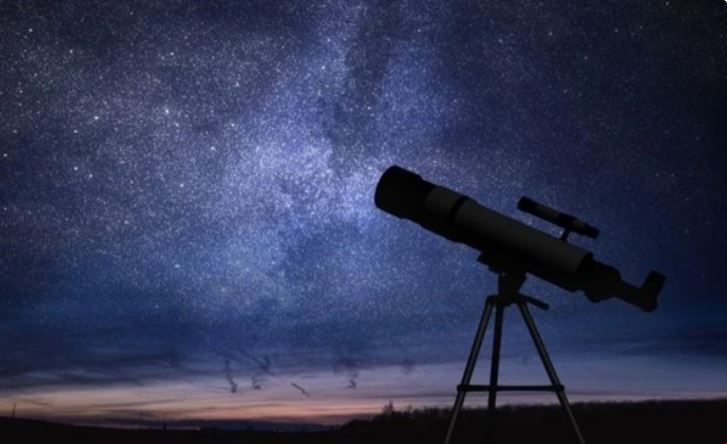
Astronomers discover a mysterious star like never before
A team of astronomers has claimed that observations of a sun-like star orbiting a small black hole may actually be an indication of something even stranger: the presence of a boson star made entirely of dark matter.
The yet to be reviewed study, published in the journal arXiv, evaluated data from the European Space Agency's Gaia satellite on a cosmic system consisting of a sun-like star and a companion stellar that is about 11 times more massive than the sun.
These objects revolve around each other at a distance of 1.4 astronomical units - or the equivalent of the distance that Mars revolves around the sun - as scientists say, including those from the Czech Academy of Sciences.
Previous research predicted that the system consists of a star orbiting a black hole. While a possible explanation for the central body could be a black hole, the orbital mechanics of the system are also explained if the central dark body is a stable conglomeration of bosonic particles (fields that carry energy) or "dark matter".
Dark matter is an invisible substance that is thought to make up most of the mass in the universe. Most models suggest that dark matter is evenly distributed throughout the universe, but some say it could also clump together.
In one such model, dark matter is hypothesized to be a new type of boson, a particle that carries energy and forces through the universe like the widely known photon.
Scientists assumed that some of the undiscovered bosons could have the ability to form large masses, and some of them could theoretically be the size of an entire star.
Scientists say such a hypothetical cosmic body, known as a star boson, would be completely invisible because these boson particles do not interact with light but can be identified by the gravitational effect on their surroundings.
The new study suggests that the Gaia satellite observations data can be explained by replacing the central body with a boson star.
Boson stars are the result of a hypothetical form of dark matter. Dark matter itself makes up more than 80 percent of the total mass of every galaxy and is made of a type of particle that is still far from modern physics. In some dark matter theories, dark matter is made up of bosons, which are a type of particle like photons and gluons — particles that typically carry forces of nature. But dark matter bosons would be different, and would instead populate most of the universe.
But because of their nature, boson dark matter particles can easily aggregate into dense, compact bodies. These objects will not emit any radiation at all and will appear to outside observers as black holes.
Reality Of Islam |
|
Changing a

Plants are

After spend
A study of
 9:3:43
2018-11-05
9:3:43
2018-11-05
10 benefits of Marriage in Islam
7:5:22
2019-04-08
benefits of reciting surat yunus, hud &
9:45:7
2018-12-24
advantages & disadvantages of divorce
11:35:12
2018-06-10
6:0:51
2018-10-16
7:0:55
2022-05-17
3:43:50
2022-11-05
9:50:37
2023-02-28
6:14:3
2023-01-18
12:10:56
2022-11-17
2:33:4
2023-02-15
7:6:7
2022-03-21
5:41:46
2023-03-18
| LATEST |
 HOME
HOME