الوضع الليلي


 3:6:54
  2024-12-03
  1998
1998
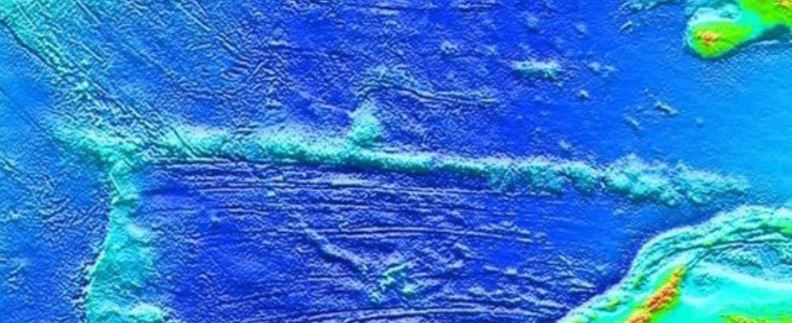
The Indian Ocean is home to a mountain range longer than the North American Rockies, and yet today, all 5,000 kilometers (3,107 miles) of it are hidden under the sea.
A new study delves deep beneath the waves to show how the Ninetyeast Ridge was formed between 43 and 83 million years ago – and its origins are quite the surprise.
Seamounts are underwater volcanoes found in every single ocean. They are caused by 'hotspots' beneath Earth's surface, in which gathering heat melts away the mantle, releasing hot plumes in a pipe-like upwelling.
At first, scientists did not think hotspots could move, so a trail of volcanoes underwater was thought to result from tectonic plates sliding over the top of a stationary hotspot. Think of it like an upside-down sewing machine, with a stationary 'needle' of hot material piercing a cloth sliding above it, stitching a line.
As it turns out, the Indian Ocean's submerged volcanic chain was formed in a different way. The hotspot in this case is better imagined as a fountain pen, with the moving 'tip' depositing liquid magma across the surface of the Earth.
"Unlike most volcanic hotspots that remain stationary in the mantle and create volcanic trails as tectonic plates drift over them, this study found that the hotspot responsible for the Ninetyeast Ridge moved by several hundred kilometres within the mantle over time," explains geoscientist Hugo Olierook from Curtin University in Australia.
"This kind of hotspot movement is thought to be common but is hard to prove and has only previously been demonstrated for a few hotspots in the Pacific Ocean, making this the first documented case in the Indian Ocean."
The Kerguelen hotspot is the one responsible for creating the Indian Ocean's vertical underwater scar, and inconclusive studies have suggested the hotspot may have moved southward or westward over time.
Researchers in Australia, Sweden, China, and the US have now analyzed basalt samples from the Ninetyeast Ridge to support that idea.
Their results suggest that the Kerguelen mantle plume was created when the Indian Plate began to drift northward, opening up the Indian Ocean.
If the Kerguelen hotspot had remained fixed below the Indian Plate during this movement, then the ridge would have moved northward at the same rate as the seafloor spreading.
But that is not what the team found.
Between 83 and 66 million years ago, radioisotopic dating suggests, the peaks of the mountain range were created at roughly half the rate of the seafloor spreading.
This means "the Kerguelen hotspot was not fixed beneath the Indian Plate," writes the international team of researchers, led by Qiang Jiang from the China University of Petroleum.
It's hard to explain why the hotspot moved at this rate, but Jiang and colleagues argue "the most likely scenario is that the mantle plume was captured by the northward-migrating Indian-Antarctic spreading ridge, and plume materials flowed continuously towards the spreading ridge and erupted at the ridge."
About 66 million years ago, the plume was "disconnected" when the spreading ridge started drifting too far away. Later, the plume was temporarily captured again, this time by the western spreading ridge.
By roughly 42 million years ago, the hotspot had drawn a vertical line that now separates the Indian Ocean into east and west.
"For years, rough age estimates of the Ninetyeast Ridge have been used to construct models of how Earth's tectonic plates moved and reconfigured," says earth scientist Fred Jourdan from Curtin.
"By using high-precision dating we can refine these models significantly.
Reality Of Islam |
|

Keeping sil
Two experim

Changing a
Plants are
 9:3:43
2018-11-05
9:3:43
2018-11-05
10 benefits of Marriage in Islam
7:5:22
2019-04-08
benefits of reciting surat yunus, hud &
9:45:7
2018-12-24
advantages & disadvantages of divorce
11:35:12
2018-06-10
6:0:51
2018-10-16
8:39:51
2022-09-23
1:34:8
2022-02-01
7:0:55
2022-05-17
11:11:59
2023-02-01
7:32:24
2022-02-14
7:26:19
2022-04-08
8:19:41
2018-06-21
5:41:46
2023-03-18
| LATEST |
 HOME
HOME