الوضع الليلي


 10:57:57
 2024-06-08
 2240
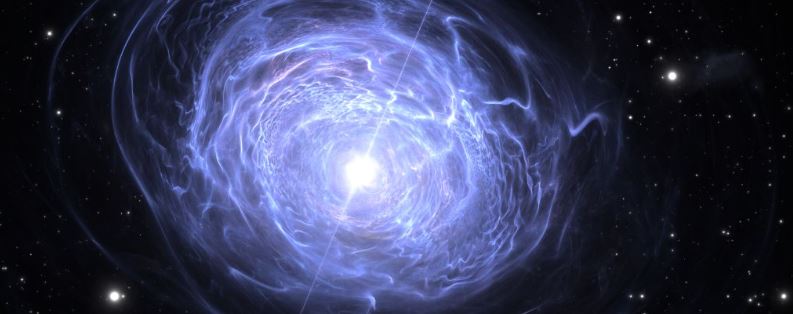
We've received a strange signal from across the galaxy, and astronomers are struggling to understand what it means.
They know what's emitting the signals. It's a neutron star named ASKAP J193505.1+214841.0 (ASKAP J1935+2148 for short), located in the plane of the Milky Way, some 15,820 light-years from Earth.
But the signals themselves are like none we've ever seen before. The star goes through periods of strong pulses, periods of weak pulses, and periods of no pulses at all.
What we don't know, according to a team led by astrophysicist Manisha Caleb of the University of Sydney in Australia, is why. The strange object poses a fascinating challenge to our models of neutron star evolution – which, let's be honest, are currently pretty far from complete.
A neutron star is what's left after a star within a certain mass range dies, between about 8 and 30 times the mass of the Sun. The star's outer material is blasted off into space, culminating in a supernova explosion.
The leftover core of the star collapses under gravity, forming an ultra dense object up to 2.3 times the mass of the Sun, in a sphere just 20 kilometers (12 miles) across.
The neutron star that results can then present in a variety of ways. There's the base neutron star, which just hangs out not doing a great deal. There's the pulsar, which sweeps beams of radio emission from its poles as it rotates, flashing like a cosmic lighthouse.
And there's the magnetar, a neutron star with an extremely powerful magnetic field, which jerks and erupts as the outward pull of that magnetic field wars with the gravity keeping the star together.
There can also be some rare crossover between the neutron star types, suggesting that they may be different stages of neutron star evolution. Generally, however, pulsars, magnetars, and neutron stars tend to behave in relatively predictable ways.
ASKAP J1935+2148 does not behave in ways that are normal for a neutron star of any established kind. It was first identified serendipitously during observations of a different target, and follow-up observations were made using the Australian Square Kilometre Array Pathfinder (ASKAP) and the MeerKAT radio telescope in South Africa.
The researchers also dove into previous ASKAP observations covering the same patch of sky.
They found that ASKAP J1935+2148 has a regular period of pulses of 53.8 minutes… but that seemed to be the only normal thing about its pulsations. One pulsation mode, they found, was extremely bright, with highly linear polarization. But then it would subside completely, with no measurable pulsations at all for a period.
Finally, the star was detected resuming its pulsation activity – but a whopping 26 times fainter than its earlier bright mode, and with light that is circularly polarized.
In recent years, several strange objects have been found spitting out repeating signals in the southern sky. Although they don't all behave the same way, they could be related.
GLEAM-X J162759.5-523504.3 is an object near the galactic center that was caught spitting out bizarrely bright flashes for just three months before falling quiet again. GPM J1839-10 was found to behave like a bizarrely slow pulsar, emitting five-minute bursts of radio waves every 22 minutes. And GCRT J1745-3009 is a pulsing object near the galactic center with a period of 77 minutes.
We don't know for a certainty what any of these objects are, but neutron stars seem likely. And ASKAP J1935+2148, Caleb and her colleagues suggest, could be a sort of bridge between the different states.
The differences between its pulsation modes are likely connected to magnetospheric changes and processes, suggesting that all the objects belong to a new class of magnetars, possibly as they evolve into pulsars.
"ASKAP J1935+2148 is probably part of an older population of magnetars with long spin periods and low X-ray luminosities, but magnetized enough to be able to produce coherent radio emission," the researchers write in their paper.
"It is important that we probe this hitherto unexplored region of the neutron-star parameter space to get a complete picture of the evolution of neutron stars, and this may [be] an important source to do so."
Reality Of Islam |
|

A faster wa

Metal foam

By filling
 9:3:43
2018-11-05
10 benefits of Marriage in Islam
7:5:22
2019-04-08
benefits of reciting surat yunus, hud &
9:45:7
2018-12-24
advantages & disadvantages of divorce
11:35:12
2018-06-10
6:0:51
2018-10-16
8:3:0
2018-06-21
7:0:55
2022-05-17
6:14:17
2018-06-21
5:57:34
2023-03-18
4:2:19
2022-10-10
11:11:59
2023-02-01
1:16:44
2018-05-14
5:41:46
2023-03-18
| LATEST |
 HOME