الوضع الليلي


 3:32:47
 2023-10-04
 1690
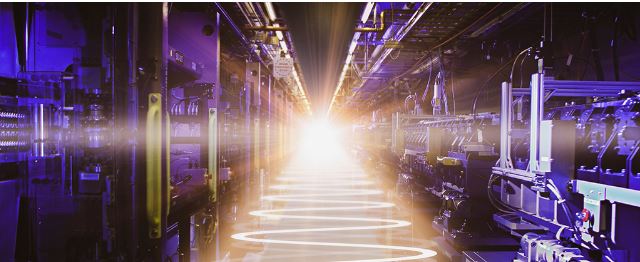
The boundaries of science are constantly being pushed and expanded as newer and more advanced technology is developed, and researchers are now promising a "new era" of discovery as the worlds most powerful X-ray laser comes online.
The laser in question is the Linac Coherent Light Source (LCLS) ll, and it's able to produce up to a million X-ray flashes every single second. That's some 8,000 times more than the original LCLS laser, creating a virtually continuous beam of highly energetic light that is 10,000 times brighter than before.
That means it can capture processes in much more detail at the atomic scale, perhaps processes that have never been properly observed before – and from there, maybe opening up completely new fields of research.
Think about studying quantum events at a higher resolution than ever before, or capturing chemical processes that are over in the smallest slither of time – from reactions on solar panels to the structures of cells to new drug types.
The machine is located at the SLAC Natiomal Laboratory in California, and it's operated by Stanford University for the US Department of Energy. The announcement of its "first light" comes after more than a decade of development and more than a billion dollars of investment.
"The light from SLAC's LCLS-II will illuminate the smallest and fastest phenomena in the Universe and lead to big discoveries in disciplines ranging from human health to quantum materials science," says US Secretary of Energy Jennifer Granholm.
Specifically, LCLS-II is an X-ray free-electron laser (XFEL), where free electrons are accelerated towards light speed velocities to produce super-bright and super-quick flashes of light at super-short wavelengths – like a camera flash going off at a rate far beyond what the human eye can perceive.
There's a whole host of cutting-edge technology packed in to the laser, including a superconducting and a collection of 37 cryogenic modules running at super-low temperatures, which can propel electrons with hardly any energy loss.
There are also two new undulators – one 'soft' or low energy and one 'hard' or high energy – which are responsible for generating the X-ray light from the speeding electrons, a crucial part of the overall process.
There are only a handful of XFELs in the world, and they've already led to important jumps forward in our understanding of phenomena such as cosmic weather and the photosynthesis process. Now, much more will be possible.
The ability for these devices to capture 'molecular movies' of the smallest, briefest interactions in science – at the speed that electrons move, or the attosecond timescale – will have implications for physics, chemistry, biology, engineering, and materials science.
"Experiments in each of these areas are set to begin in the coming weeks and months, attracting thousands of researchers from across the nation and around the world," says LCLS Director Mike Dunne.
Reality Of Islam |
|
A faster wa
Metal foam

By filling
 9:3:43
2018-11-05
10 benefits of Marriage in Islam
7:5:22
2019-04-08
benefits of reciting surat yunus, hud &
9:45:7
2018-12-24
advantages & disadvantages of divorce
11:35:12
2018-06-10
6:0:51
2018-10-16
2:5:14
2023-01-28
9:39:36
2022-12-28
allah will not answer all your prayers
6:56:28
2022-01-01
4:26:43
2022-02-21
1:34:8
2022-02-01
8:3:0
2018-06-21
5:58:12
2021-12-18
5:41:46
2023-03-18
| LATEST |
 HOME